
Unthinkable 30 years ago, today just a matter of a few clicks: home music production.
Nowadays, basically anyone can produce music and release it. In the age of “so simple even a trained monkey could use it” DAWs, and especially with the help of music AIs like suno, the barriers to producing and releasing music are lower than ever.
You no longer need expensive, high-end equipment or special prior knowledge. Not even basic music theory is truly required. DAWs like FL Studio have features where you simply specify which key you want, and the software then automatically removes all notes from the piano roll that do not match that key.
I do this as a hobby too – and let’s be honest, it is a hobby and cannot replace a proper, regularly paid job. Reason enough for a “10 facts” post about music production in general and indie artists in particular.
1. First and foremost: you cannot live from this
Anyone who makes music is basically a star. And stars have money! Not as an indie. Not without a label, major marketing, and enough luck to somehow stand out from the masses and “make it.”
The average indie has more costs than income from this hobby. Streaming services usually pay extremely poorly, and streaming is what mainly happens today. Music consumption takes place primarily on Spotify, Amazon Music, Tidal, Deezer, Apple Music, and so on. That someone actually buys a single or album and downloads MP3s, or even purchases a physical medium, is extremely rare nowadays.
For artists, streaming is not very profitable. There is a reason why, during the normal and light COVID lockdowns, even established, major artists were complaining loudly. They may easily reach millions of streams, but real income comes from merchandise and concert tickets, not from streaming. Spotify, probably the biggest and best-known streaming service, is also a good example here, as it often pays among the worst. To earn one euro (again: €1) from a song, that song needs between 200 and 333 streams.
To make this even clearer, here are my total streaming earnings from all platforms combined:

These are all revenues from May 2022, when I started releasing my songs, through December 2025. From all platforms, not just Spotify. And even though I am a rather small indie artist, I manage to get close to 100,000 streams on some tracks so far.
In addition, I also publish my music on Bandcamp. There, artists or labels sell directly: you pay a price set by the artist or label (or more, if you like) and receive high-quality digital copies that you can download. Anyone who believes there must be a lot to earn there is mistaken.
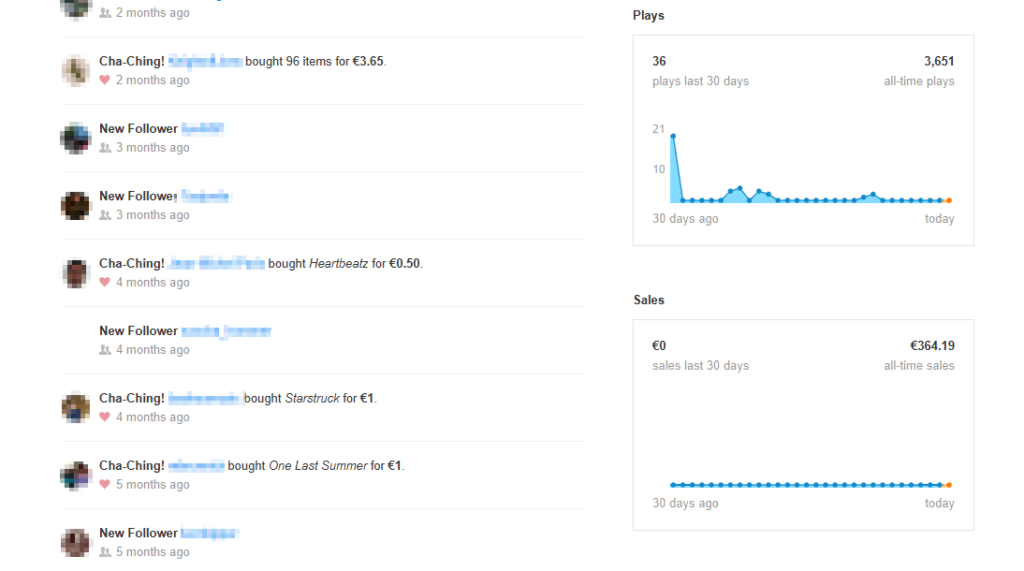
The reason is simple: hardly anyone knows Bandcamp. That is somewhat surprising, considering it ultimately belongs to Sony, but that is how it is. And it is rather difficult to convince people to use Bandcamp. The UI is not hip or trendy, neither online nor in the app. And as mentioned, people prefer streaming over buying nowadays.
For comparison: the annual fee for Distrokid to distribute my songs is around €50. Promoted posts and ads on Meta, X, and YouTube to gain more reach and hopefully more streams and sales usually cost between €20 and €40 per post. The production software, DAW, plugins, VSTs, and so on are also not cheap. If I add up DAW, plugins, sample subscriptions, and VSTs, I have easily spent €900 to €1,200 since 2022 to set up my workspace the way I like it.
Without a label, luck, and massive marketing behind you, this is an expensive hobby. You cannot live from it. But at least you can say: “I am involved in music production!” 🙂
2. Amateur music production takes no effort
Yes. And no.
Sure, there are indie artists whose tracks sound like they just clicked around for five minutes and then hit “upload.” But for most, there is actually a lot of work behind it. For some, even more than one might think.
Many people seem to believe that music is only “real” if it is recorded in the traditional way, in a studio with multiple musicians playing “for real.” Fun fact: even “real” musicians and pros record their own tracks individually, and in the end a producer and sound engineer stitch everything together. That is how albums by Status Quo, Queen, AC/DC, Metallica, and many others were made as well. The whole band never stood in the studio playing a live in-house concert that someone recorded. That is not how it works. Everyone goes into the studio separately and records their part. Afterwards, someone painstakingly assembles everything into a complete song. In the past with tape (magnetic tape, not “band” as in music group 🙂 ), today digitally.
All in all (composition, arrangement, mixing), I spend between 2 and 10 hours on a single track.
3. Is the effort worth it?
That depends entirely on your personal definition of “worth it.” You always have to remember: I do this for fun, it is my hobby. I do it 99% for the reason “I have melodies and rhythms in my head and they need to get out,” and 1% for the reason “With a bit of luck someone might like it and I can feel good when people enjoy my noise.”
For me, the effort is absolutely worth it in that sense. The melodies and rhythms are out of my head, and a small but real number of people listen to them every month and seem to like them. That covers 100% of my motivation.
4. Less is more
One of the cardinal mistakes in music production is thinking that everything always has to be very complex. Many of my tracks have only a few tracks and individual instruments. Sometimes, you can achieve a big effect with very little. Not every track needs 17 different basses, 23 different synths, and 91 different pads. Some of my tracks have a very minimal foundation.
5. Sometimes little is not enough either
To completely contradict the previous point, here is my favorite example: I have one track where the snare consists of a ridiculous number of individual samples and effects. Strictly speaking, the snare is not even a snare. It is an open hi-hat with lots of delay, reverb, pitch shifting, and many other effects.
My kick drum is also rarely just a single kick. To achieve the sound I had in my head, I often combine several different sounds and then process them with effects, balance changes, and so on. Sometimes a sound is not even an instrument, but a recording of me hitting a cup with a spoon, and the rest are dozens of effects. Music production is very often an experimental science.
6. You cannot produce music as a layperson
You can. It just often sounds terrible. You should learn at least a basic level of music theory and how to mix and produce properly.
That can easily be done without a degree or formal training. There are countless good tutorials online, and many producers share videos on YouTube where they openly explain their methods.
You can learn it as a layperson, but yes, you have to actually learn it. Otherwise, it just does not sound good.
7. Listeners live in a different world
What do I mean by that? Simply this:
As an artist, you sometimes spend hours on a track, adjusting sliders until you believe it sounds equally good on many different devices. That is an illusion, because there are far too many different playback devices. And in doubt, listeners do not care about the same quality criteria you do, while you obsess for hours over a single hi-hat.
Music production and music consumption are two completely different worlds. As an artist, you may spend an hour or more tweaking a certain sound, only for no one to notice except yourself, because most listeners will later play the track on their smartphone.
You simply cannot take that too personally. You cannot change it. Instead of torturing yourself for hours over how to mix the track perfectly for all devices, just work in a way that makes you satisfied in the end.
8. Music production is only half the job
If, as an indie artist, you want the results of your work to reach people, you cannot lean back after finishing a track in the studio. In reality, you spend far more time posting about your tracks on countless social media platforms, creating cover art, designing promo posts, making videos, and so on, than you spent on the song itself.
I did not realize this before I started. Music was supposed to be the outlet, the pastime that would take me away from social media after working as a community and social media manager. That worked out well 🙂
As an indie artist, you have to do everything yourself. You have no graphics department, no advertising department, no label, no one to take care of all the things that also belong to music distribution.
9. Most tracks never get heard
Because they never even get finished. Many ideas are just that: ideas. I often sit down, start FL Studio, and sketch out an idea. Quite often I work on it for 2–3 hours, and in the end the whole thing is deleted because it simply does not fit into an overall concept.
That I have released around 200 tracks since May 2022 is therefore not an impressive number to me. What I personally find much more impressive is that a multiple of that (certainly at least double) never even made it to being saved.
10. Producing music can reduce the enjoyment of listening to music
Most people listen to music and think, “Great beat!” or “Nice melody!”
As someone who produces music myself, I often no longer consume music purely for enjoyment or as background noise, but instead constantly think about how I would have made this or that sound.
That is not as fun as it sounds. If, instead of enjoying the track, you spend half of it mentally breaking it down into pieces and wondering how each effect was used and whether you would have done it the same way, that is not exactly conducive to enjoying the music.